



Home / Training / Manuals / Atlas of breast cancer early detection / Cases
Atlas of breast cancer early detection
Filter by language: English / Русский
Go back to the list of case studies
.png) Click on the pictures to magnify and display the legends
Click on the pictures to magnify and display the legends
Click on the pictures to magnify and display the legends| Case number: | 028 |
| Age: | 62 |
| Clinical presentation: | Postmenopausal woman with average risk of developing breast cancer presented with a left breast lump noticed 4–5 months ago. |
Mammography:
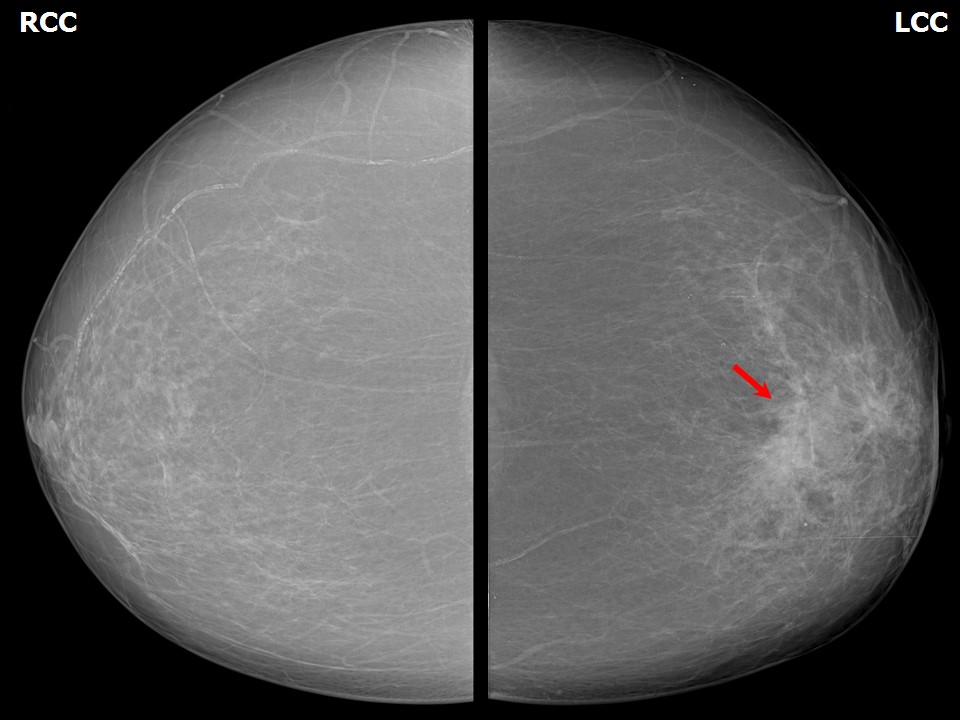 | 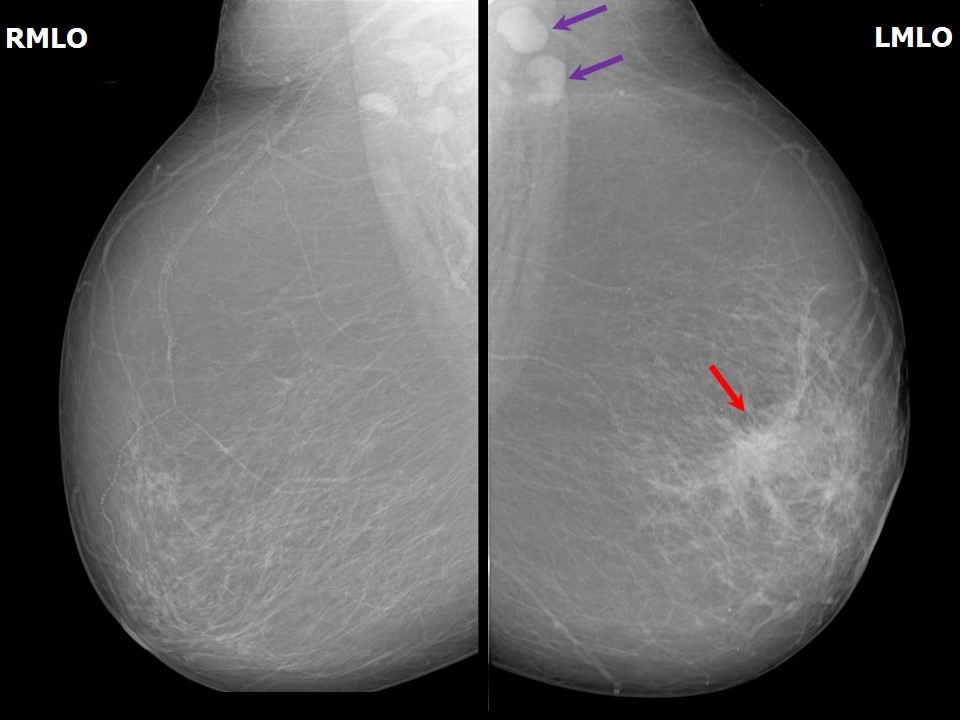 |
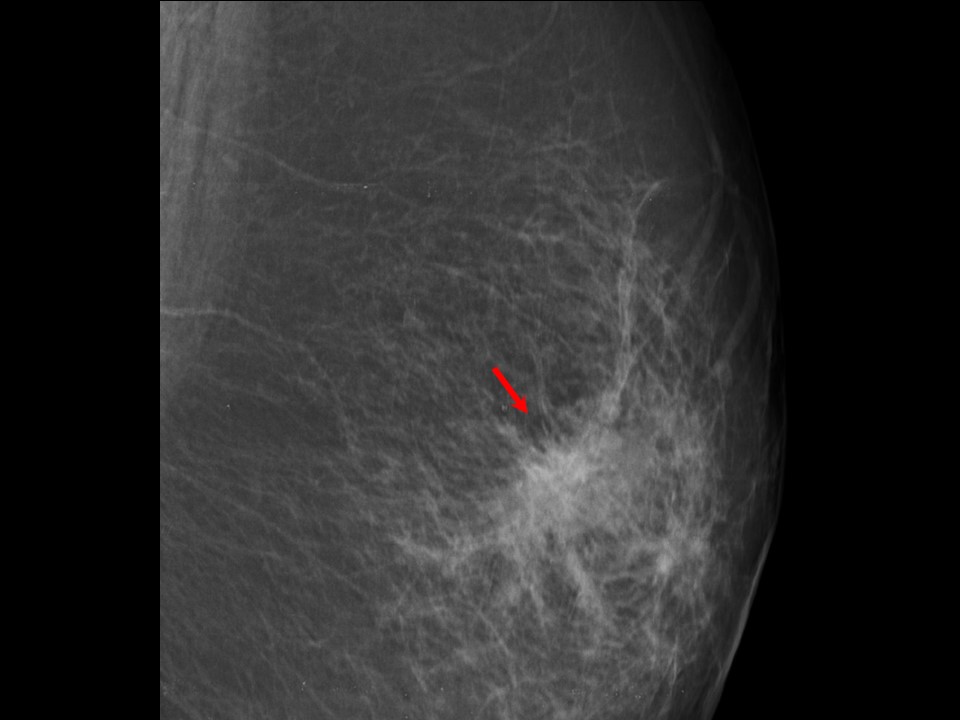 |
| Breast composition: | ACR category a (the breasts are almost entirely fatty) | Mammography features: |
| ‣ Location of the lesion: | Left breast, central portion of the breast, central zone, anterior third |
| ‣ Mass: | |
| • Number: | 1 |
| • Size: | None |
| • Shape: | Irregular |
| • Margins: | Spiculated |
| • Density: | High |
| ‣ Calcifications: | |
| • Typically benign: | None |
| • Suspicious: | None |
| • Distribution: | None |
| ‣ Architectural distortion: | Area of architectural distortion, 4.5 × 3.0 cm, with radiating linear shadows |
| ‣ Asymmetry: | Focal |
| ‣ Intramammary node: | None |
| ‣ Skin lesion: | None |
| ‣ Solitary dilated duct: | None |
| ‣ Associated features: | Axillary lymphadenopathy |
Ultrasound:
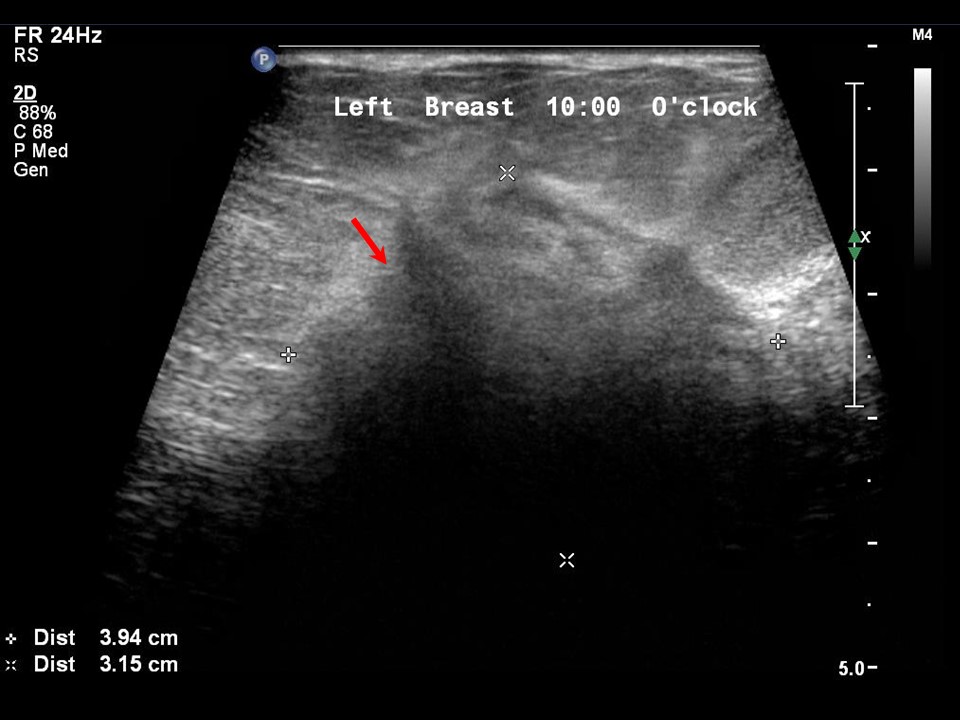 |  |
 |
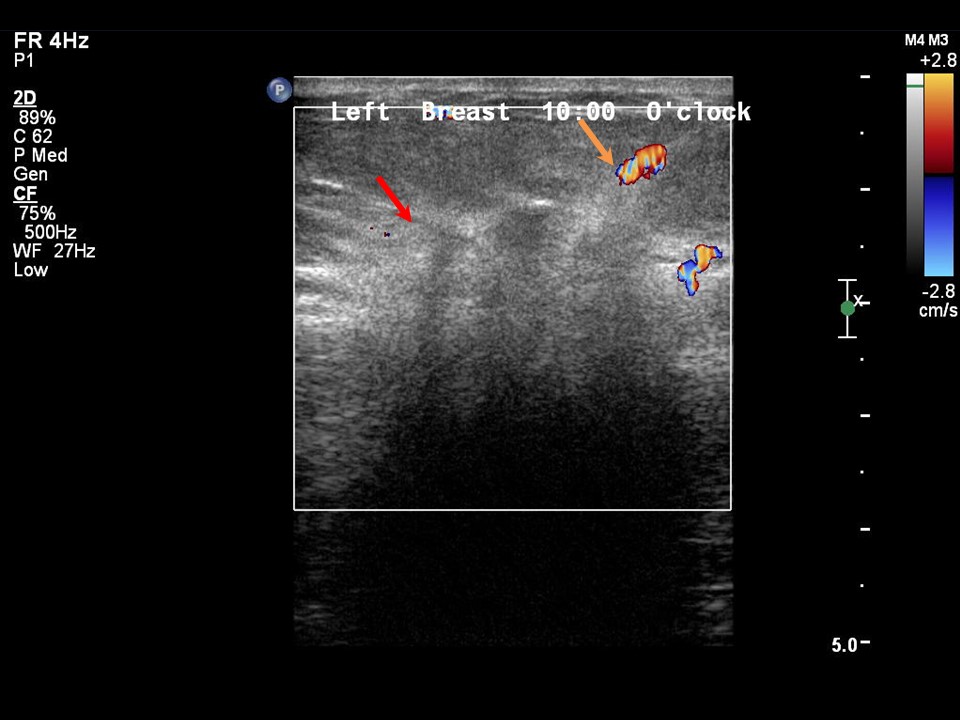
| Ultrasound features: Left breast, central portion of the breast | |
| ‣ Mass | |
| • Location: | Left breast, central portion of the breast |
| • Number: | 1 |
| • Size: | 4.0 × 3.2 cm |
| • Shape: | Irregular |
| • Orientation: | Not parallel |
| • Margins: | Spiculated |
| • Echo pattern: | Hypoechoic |
| • Posterior features: | Strong posterior shadowing |
| ‣ Calcifications: | None |
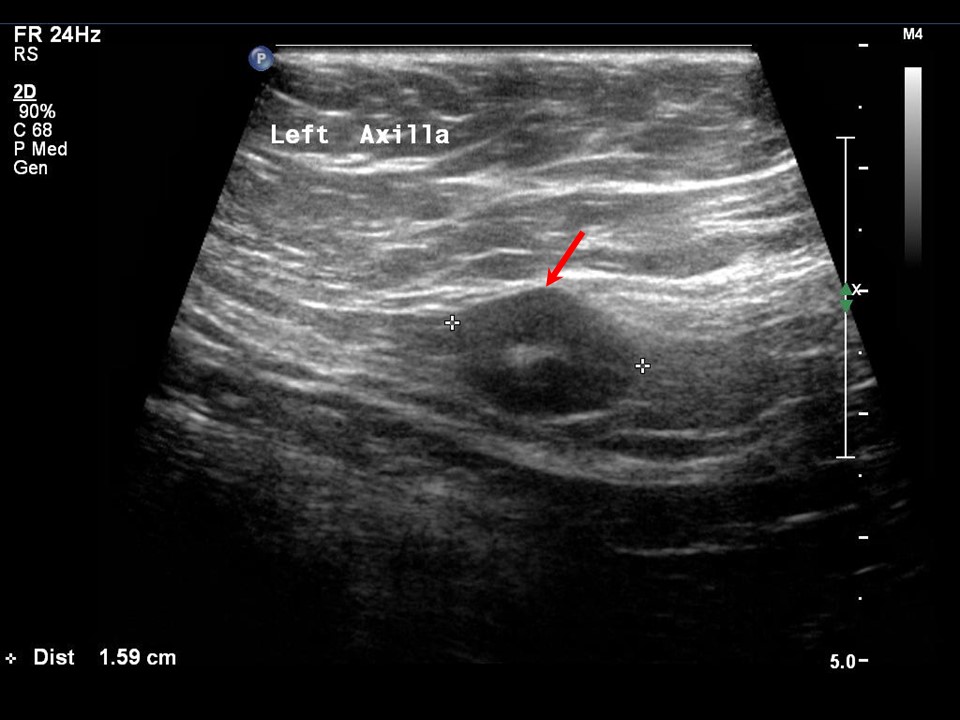
| ‣ Associated features: | Axillary lymphadenopathy with thickened cortex |
| ‣ Special cases: | None |
BI-RADS:
BI-RADS Category: 5 (highly suggestive of malignancy)Further assessment:
Further assessment advised: Referral for core biopsyHistopathology:
Core needle biopsy
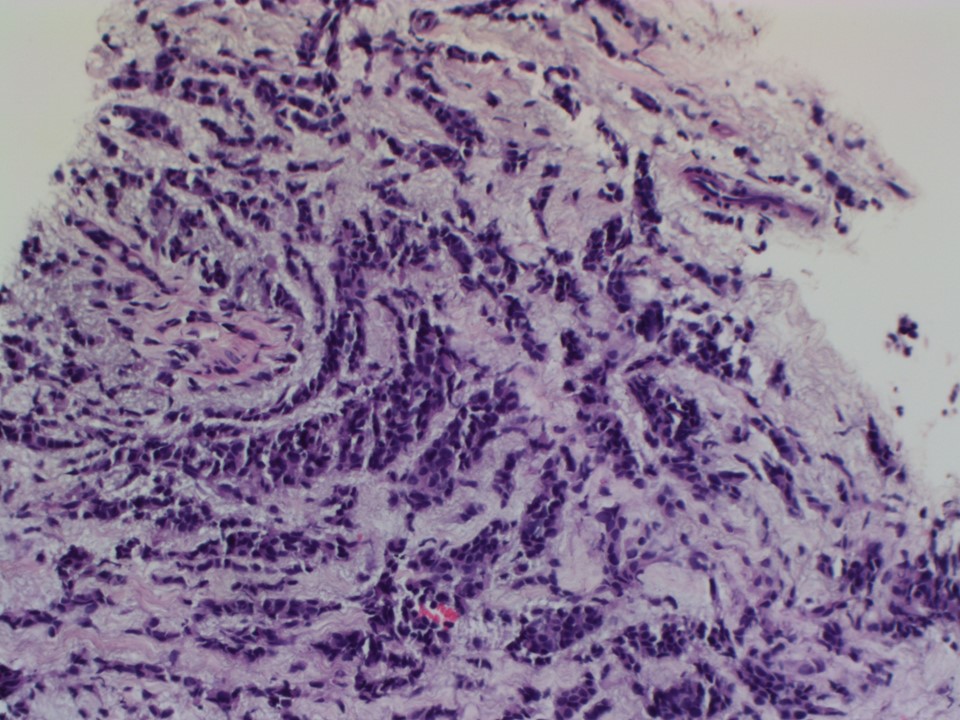 |
| Histopathology features: | |
| ‣ Specimen type: | Core needle biopsy |
| ‣ Laterality: | Left |
| ‣ Macroscopy: | Multiple whitish fragmented cores. Two long cores were 13 mm in length and 10 mm in length; the remaining multiple fragmented cores ranged in length from 2 to 3 mm |
| ‣ Histological type: | Invasive breast carcinoma of no special type |
| ‣ Histological grade: | Grade 2 (3 + 2 + 2 = 7) |
| ‣ Mitosis: | 12 |
| ‣ Maximum invasive tumour size: | |
| ‣ Lymph node status: | |
| ‣ Peritumoural lymphovascular invasion: | |
| ‣ DCIS/EIC: | |
| ‣ Margins: | |
| ‣ Pathological stage: | |
| ‣ Biomarkers: | |
| ‣ Comments: |
MRM left (after chemotherapy)
 |  |
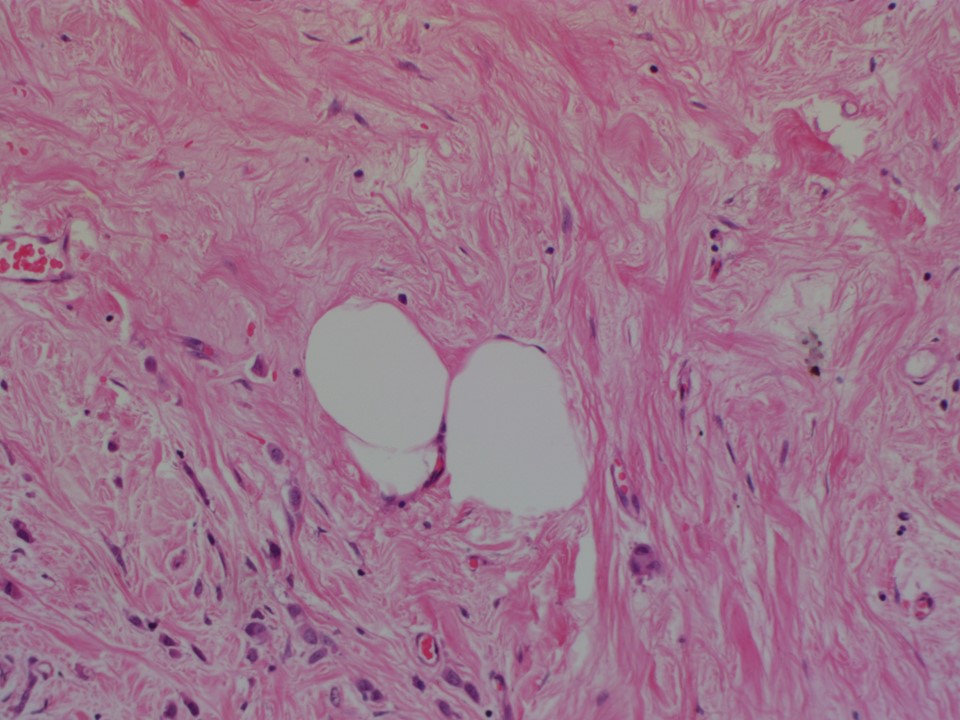 |
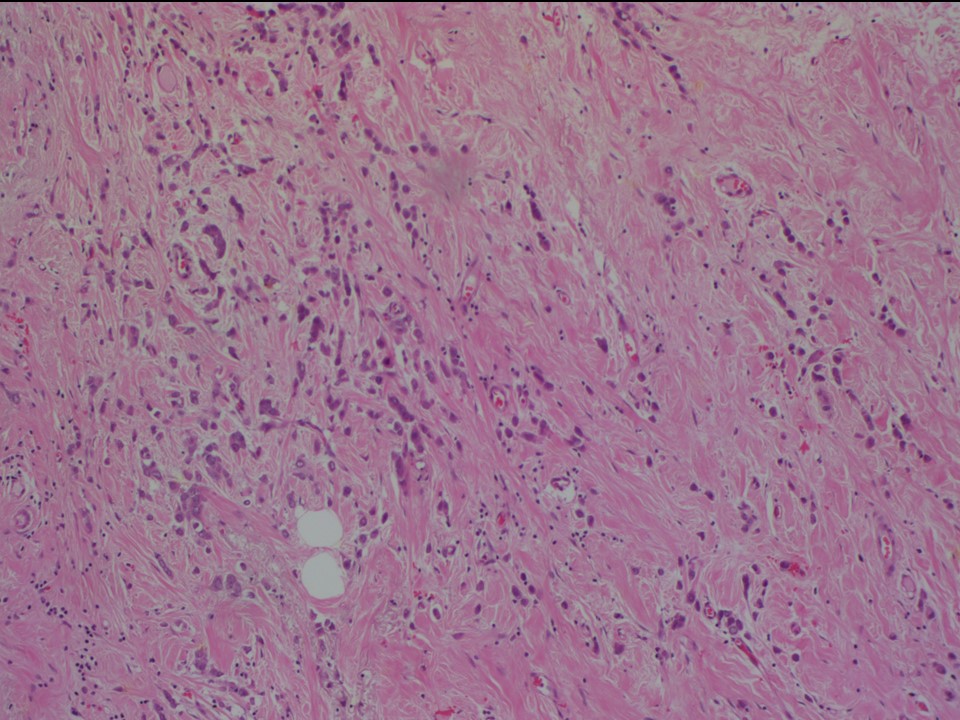
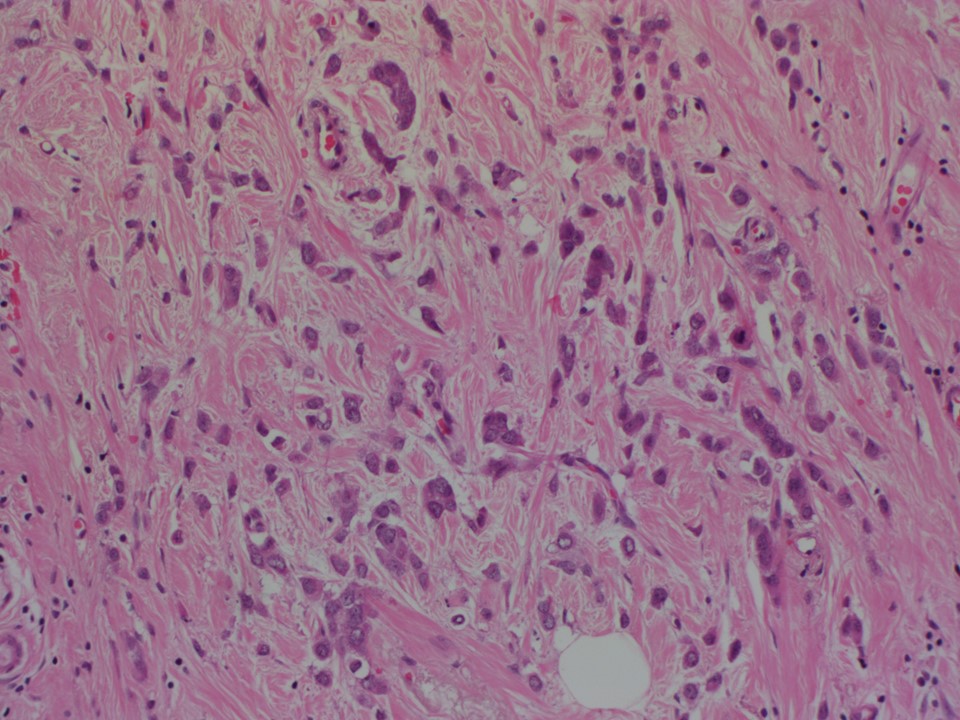
| Histopathology features: | |
| ‣ Specimen type: | MRM left (after chemotherapy) |
| ‣ Laterality: | Left |
| ‣ Macroscopy: | Left MRM specimen (25.0 × 25.0 × 7.0 cm) with overlying skin flap (20.0 × 7.0 cm). The nipple and areola are unremarkable. On serial sectioning a firm, greyish white area (4.5 × 4.0 × 3.0 cm) is identified, located in the upper inner quadrant. It is located 3.5 cm from the skin and 6.0 cm from the base. The remaining breast tissue is unremarkable |
| ‣ Histological type: | Invasive breast carcinoma of no special type |
| ‣ Histological grade: | Grade 2 (3 + 3 + 1 = 7) |
| ‣ Mitosis: | 5 |
| ‣ Maximum invasive tumour size: | 4.5 cm |
| ‣ Lymph node status: | 1/16 without extranodal extension |
| ‣ Peritumoural lymphovascular invasion: | |
| ‣ DCIS/EIC: | Very few DCIS. Solid, low nuclear grade without necrosis. EIC absent |
| ‣ Margins: | Free of tumour |
| ‣ Pathological stage: | yT2yN1 |
| ‣ Biomarkers: | |
| ‣ Comments: | Extensive fibrosis seen in the tumour bed and surrounding breast tissue |
Case summary:
| Postmenopausal woman presented with left breast lump. Diagnosed as architectural distortion with radiating linear shadows in the retroareolar region of the left breast with left axillary lymphadenopathy, BI-RADS 5 on imaging, as invasive breast carcinoma of no special type on needle core biopsy, and post neo-adjuvant therapy, MRM specimen showed residual invasive breast carcinoma of no special type, and yT2yN1 on histopathology. |
Learning points:
|